
Hennig von Bosse
Editing, Introduction and Notes by Lillian Bidal
English Translation from the German Language by Elizabeth D. Crawford
Typography, Design, Computer Graphics and Photographic Research by Louis B. McKee
Published by the Robert E. and Evelyn McKee Foundation
Copyright © TXu 874-874
June 22, 1998
Robert Walzak
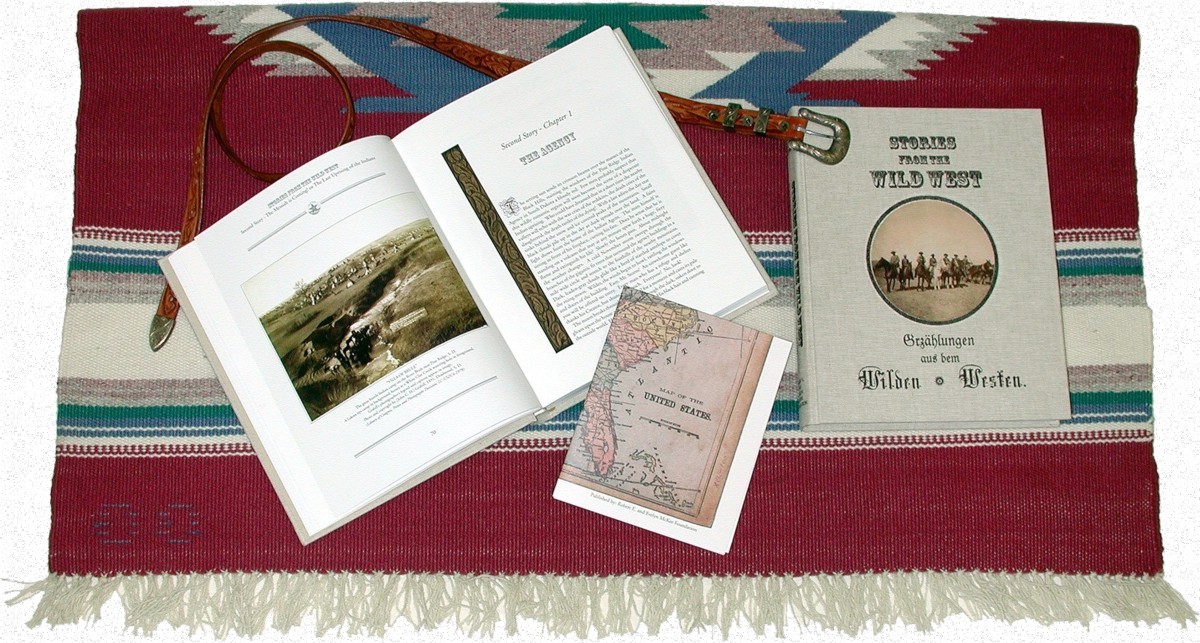
(Limited Edition of 1,500 Copies)
Also Available:
PDF eBook of the Published Book - CD
Price - $18.15, plus the cost of packaging and shipping.

Stories from the Wild West
is a hard cover Limited First Edition of 1,500 copies , 8” x 10”, 392
page book containing numerous historical photographic illustrations, color
graphics, an introduction, acknowledgments, notes and a color map insert.
This book that includes three stories - In the Land
of the Aztecs or Adventure in Mexico, The Messiah is Coming or The
Last Uprising of the Indians and The Fatefull Pegleg as well as the
original German stories published in 1898 entitled Erzählungen aus dem Wilden
Westen is now available for purchase. Books are priced at $54.50, plus
the cost of packaging and shipping.
Orders will be received in writing at the foundation
office at 5835 Cromo Drive, Suite 1, E1 Paso, Texas 79912-5501 (P. O. Box
220599, E1 Paso, Texas 79913-2599) or by Phone (915) 581-4025; Fax (915)
833-3714 and E-mail. Books will also be available at Barnes & Noble in El
Paso, Texas or by special order.
- Reviews
Sunday, June 17, 2001
El Paso Times
Books - 2F
"A German adventurer in El Paso's
Southwest"
McKee Foundation creates a beautiful book with an unusual perspective.
By Leon C. Metz - Special to the Times
I've met very few people more enamored of the
American Wild West than Germans, and author Bernhard Frederic Hennig von
Bosse was born in Braunschweig, Germany, in 1866.
When he was 15, he moved to an uncle's farm in
Missouri. From there, he herded cattle throughout the Southwest, in
the process traveling into Mexico's Sierra Madre as well as north onto the
American Great Plains and into Indian Country. Years later, working as
a German-language newspaperman in New Jersey, he decided to write down his
experiences, his autobiography about life among the Indians, among Mexican
revolutionaries, among the U.S. Army and the Indians, and among the cowboys.
His grandson discovered the autobiography during the late 1940s, and the
McKee Foundation published it originally as "Henning's Story" in 1993.
Now, we have an excellent English-language translation in "Stories from the
Wild West," (Robert E. & Evelyn McKee Foundation, limited edition of 1,500,
$54.50.)
He opens his story with visits to El Paso and Juarez
after providing a descriptive tour of Hueco Tanks. The Juarez visit in
particular has a good ring to it, Von Bosse describing the old mission plus
the nearby colorful, inviting and beckoning senoritas. He details out
door and indoor gambling scenes, all of which made deep impressions on him,
and he devotes considerable space to the bullfights, which both enthralled
and appalled him.
Once through Juarez, however, he and
his German friends take a train to Chihuahua, describe the city, and then
disappear into the Sierra Madre, evidently convinced they would find gold.
Instead, they encounter a group of revolutionaries described as important.
The freedom fighters evidently are not sufficiently upset to shoot the
Anglos. In stead, both groups meet and talk, then go their various
ways, the Germans fighting off Indian attacks before entering Hermosillo,
Sonora.
The scene shifts next to the Black Hills, in
particular the Pine Ride Indian agency. There are numerous discussions
with Cheyenne, Sioux, Crow and Kiowa Indians, all the important leaders such
as Sitting Bull and, of course, such individuals as Buffalo Bill.
This is not a first-person account, but evidently author Henning's attempt
to provide different viewpoints and interpretations involving the
Indian
wars.
The Germans shift next to their quest for the
Peg Leg Mine in the mountains of California, the searchers on one occasion
attacked by wolves with "glittering eyes and bloody tongues." Once
that danger is past, the English language terminates on page 218 with "A
Cowboy's Tribute to Will Rogers." From page 221 to book's end on page
376, the text is in German.
This is an interesting
book, a worthwhile book, and certainly different from the run-of-the-mill
books. The section narratives slip back and forth from first person
(with lots of melodrama) to third person (with lots of third-person
evaluation) - all parts, of course, having value primarily because of their
German perspective.
The numerous photos are excellent,
many of them rare pictures never before seen, at least by this reviewer.
Furthermore, this is a book on which no expense has been spared in terms of
publishing quality. The editing is excellent, the notes are well done,
the binding superior. The paper is top of the line, acid-free, heavy
and shiny, the finest stock one can purchase.
"Stories
of the Wild West" could very well survive on the shelves for 1,000 years.